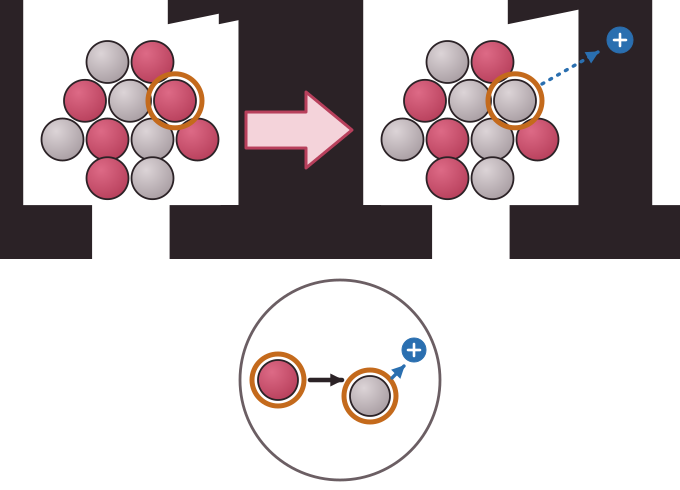
Some nuclei have too many protons for the number of neutrons they hold. One way such a nucleus becomes more stable is beta-plus (β+) decay. In this process a proton in the nucleus changes into a neutron and a positron, and the positron is thrown out of the nucleus at high speed.
A positron is a particle with the same mass as an electron but the opposite charge, so it carries a positive charge of +1. The charge is conserved: the proton had a charge of +1, the neutron has no charge, and the positron takes away the +1.
The nucleus that is left has one proton fewer and one neutron more. Its atomic number goes down by one, but the total number of protons and neutrons is unchanged, so the mass number stays the same. For example, carbon-11 (atomic number 6, mass number 11) decays to boron-11 (atomic number 5, mass number 11) and a positron. The number of protons decreases by one, so it becomes a different element.