Einstein's photoelectric effect equation :hf = φ + KEmax. Where φ is the work function of the metal. The work function is the minimum amount of energy needed to free the electron from the metal. Some electrons in the surface of the metal are closer to the positive metal ions than others. Their relative positions affect how much energy is needed to free them. Most electrons need more energy than the work function to free them, so only the electrons that need the least energy leave with the maximum kinetic energy. A graph of KEmax against frequency is a straight line.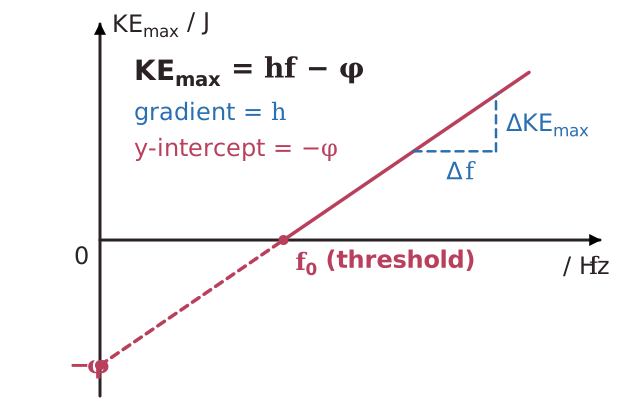 the gradient is equal to the Planck constant, and the y intercept is - φ.Different metals have different work functions.
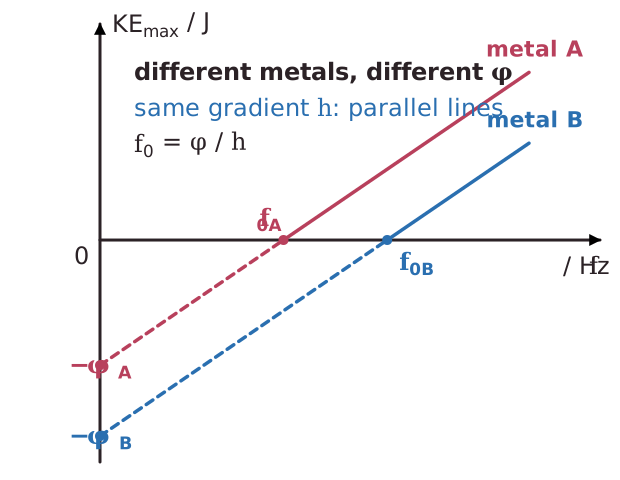 So the threshold frequency of each metal is different. Wave-particle Duality. Electrons are normally regarded as particles with both mass and charge. Electrons can be deflected by both electric and magnetic fields. This behaviour is the property of particles. In certain situations electrons diffract like waves. Anything with mass that is moving has wave properties. The wave spreads out (diffracts) as it passes through a tiny gap, and diffraction patterns can be formed. The wavelength of the electrons is given by the de Broglie equation.λ = h / mv where mv is the momentum of the electron.
the gradient is equal to the Planck constant, and the y intercept is - φ.Different metals have different work functions.So the threshold frequency of each metal is different. Wave-particle Duality. Electrons are normally regarded as particles with both mass and charge. Electrons can be deflected by both electric and magnetic fields. This behaviour is the property of particles. In certain situations electrons diffract like waves. Anything with mass that is moving has wave properties. The wave spreads out (diffracts) as it passes through a tiny gap, and diffraction patterns can be formed. The wavelength of the electrons is given by the de Broglie equation.λ = h / mv where mv is the momentum of the electron.