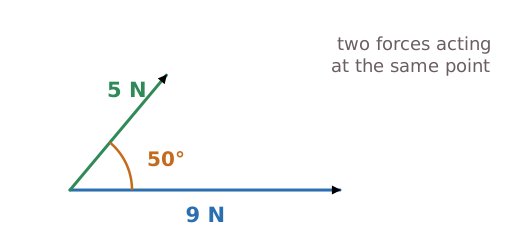
You can add two vectors that are not perpendicular using the Cosine Rule.
The resultant is the diagonal of a parallelogram with the forces comprising two sides. The angle is the supplementary angle to one of the forces.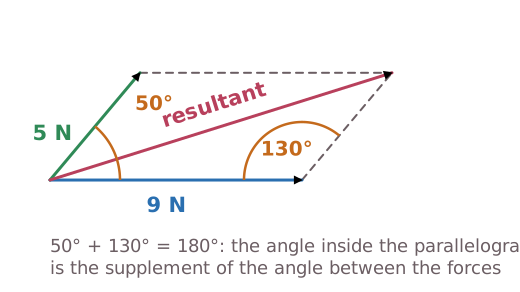
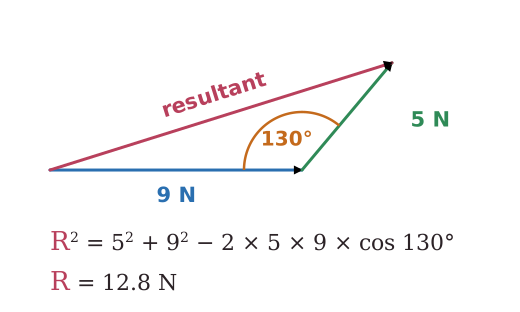
This becomes:
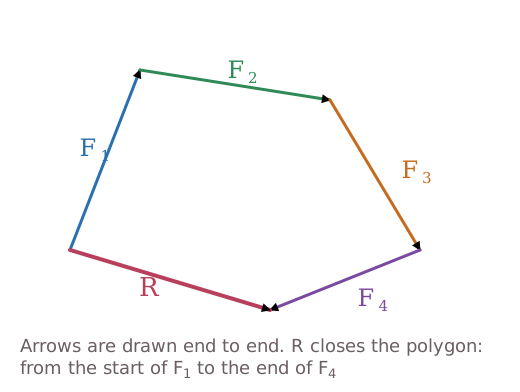
Several vectors can be added using vector polygons. Vector addition is represented by arrows drawn end-to-end. Adding more than two vectors gives a vector polygon when drawn end-to-end.
The Sine Rule can be used to calculate the angle the resultant makes with one of the forces.
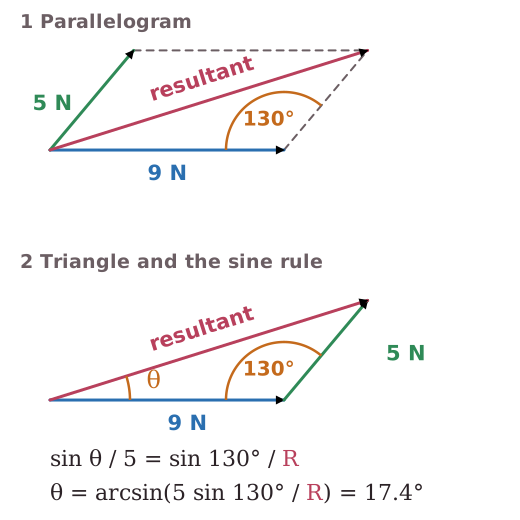
The resultant is the diagonal of a parallelogram with the forces comprising two sides. The angle is the supplementary angle to one of the forces.
This becomes:
Several vectors can be added using vector polygons. Vector addition is represented by arrows drawn end-to-end. Adding more than two vectors gives a vector polygon when drawn end-to-end.
The Sine Rule can be used to calculate the angle the resultant makes with one of the forces.