Skip to content

Resolving Momentum

Momentum is a vector, so like any vector it can be split into two perpendicular components. Resolving momentum makes it possible to apply conservation of momentum to objects that move in different directions.An object of mass m moving with velocity v at an angle θ to the x-axis has momentum p = mv. Its component along the x-axis is mvcosθ and its component along the y-axis is mvsinθ.
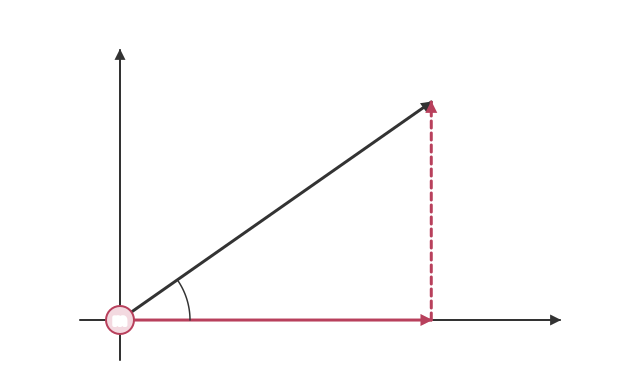
In a collision, momentum is conserved separately in each direction. The total momentum in the x direction before the collision equals the total momentum in the x direction afterwards, and the same is true in the y direction.When resolving, choose a positive direction for each axis. Components in the opposite direction are negative. Once the final x and y components are known, they can be combined with Pythagoras' theorem to find the size of the momentum and with tanθ to find its direction.

Read the text

Read the text and highlight anything you think is important. When you go on, the text is hidden and you answer from memory.

Specification: OCR Physics A (H156), AS-level, 3.5.1 Newton's laws of motion. Topic: Momentum.

Key terms in this lesson

density
The mass per unit volume of a substance.
energy
The capacity of a system to do work.
resistance
The ratio of the potential difference across a component to the current through it.
thermistor
A resistor whose resistance changes significantly with temperature, typically made from a semiconductor.
light dependent resistor
A resistor made from a semiconductor material whose resistance decreases as the intensity of light on it increases.

More in Momentum

All 14 lessons in Momentum · All OCR AS-level Physics topics