Newton's second law states that the resultant force on an object equals its rate of change of momentum, F = Δp/Δt. Rearranging gives FΔt = Δp. The product of the force and the time for which it acts is called the impulse.Impulse is equal to the change in momentum. Its unit is the newton second (N s), which is equivalent to kg m s-1, the unit of momentum.
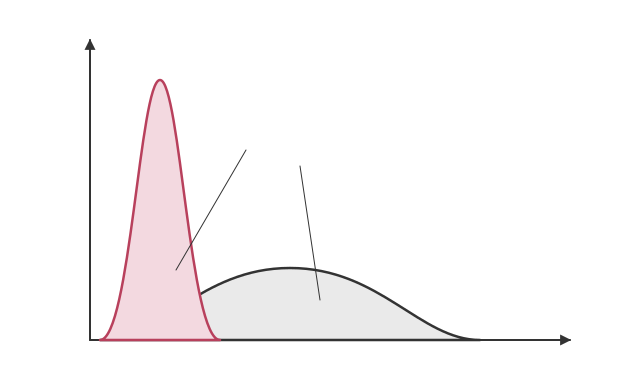
On a force-time graph, the area under the graph is the impulse. This is true even when the force varies, as it does during a real collision, where the force rises to a peak and then falls. The area can be found by counting squares or by splitting it into simple shapes.The same change in momentum can be produced by a large force for a short time or a small force for a long time. Crumple zones, airbags and crash mats increase the time of an impact, so the average force on a person is smaller for the same impulse.
Impulse and Force-time Graphs
Read the text
Read the text and highlight anything you think is important. When you go on, the text is hidden and you answer from memory.
Specification: OCR Physics A (H156), AS-level, 3.5.1 Newton's laws of motion. Topic: Momentum.
Key terms in this lesson
- energy
- The capacity of a system to do work.
- potential difference
- The work done, or energy transferred, per unit charge as charge moves between two points in a circuit.
More in Momentum
- Conservation of Momentum
- Explosions vs Collisions
- Elastic and Inelastic Collisions
- Air Bags
- Conservation of Momentum as a Consequence of Newton's Laws
- Adding Momentum
- Resolving Momentum
- Conservation of Momentum in Two Dimensions
All 14 lessons in Momentum · All OCR AS-level Physics topics