Skip to content

Hooke's Law

If a range of forces are used to extend a spring, it undergoes elastic deformation and the force-extension graph is a straight line through the origin up to a limit.This means that the force is directly proportional to the extension up to the limit of proportionality. If the force is removed, the spring returns to its original length.If the spring is stretched further it reaches its elastic limit. At this point the spring undergoes plastic deformation and does not return to its original length when the force is removed.
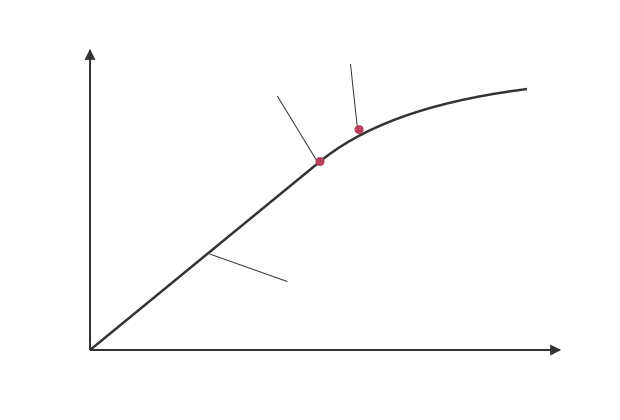
Hooke's Law states that the extension of a spring is directly proportional to the force applied provided the limit of proportionality is not exceeded.

Read the text

Read the text and highlight anything you think is important. When you go on, the text is hidden and you answer from memory.

Specification: OCR Physics A (H156), AS-level, 3.4.1 Springs. Topic: Materials.

Key terms in this lesson

resultant
The single force or vector that has the same effect as two or more forces or vectors acting together.
velocity
The rate of change of displacement of an object; speed in a given direction.
acceleration
The rate of change of velocity of an object.
linear momentum
The product of an object's mass and its velocity.

More in Materials

All 14 lessons in Materials · All OCR AS-level Physics topics