Question: a uniform plank of length 4.0 m and weight 200 N rests horizontally on two supports, A at the left end and B at the right end. A person of weight 600 N stands 1.0 m from A. Calculate the upward forces RA and RB from the supports.
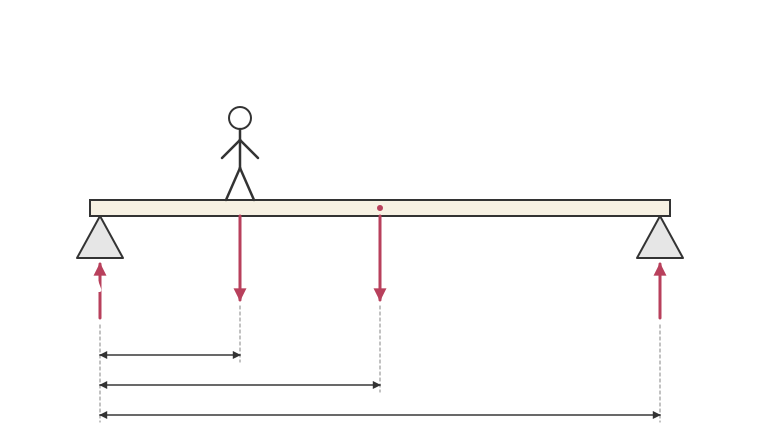
Step 1: find the centre of gravity. The plank is uniform, so its 200 N weight acts at its midpoint, 2.0 m from A.Step 2: take moments about A. Choosing A as the pivot removes the unknown RA, because a force has no moment about the point where it acts.Clockwise moments about A = (600 × 1.0) + (200 × 2.0) = 600 + 400 = 1000 N mAnticlockwise moment about A = RB × 4.0RB × 4.0 = 1000, so RB = 250 N Step 3: balance the vertical forces. The plank is in equilibrium, so total upward force = total downward force.RA + RB = 600 + 200 = 800 N RA = 800 - 250 = 550 N Check: taking moments about B gives RA × 4.0 = (600 × 3.0) + (200 × 2.0) = 2200 N m, so RA = 550 N, as before.The support nearer the person carries more of the load, as expected. Remember to include the weight of the beam itself: forgetting it is the most common mistake in this type of question.
Moments Question 2
Read the text
Read the text and highlight anything you think is important. When you go on, the text is hidden and you answer from memory.
Specification: Edexcel Physics (8PH0), AS-level, Topic 2: Mechanics. Topic: Motion.
Key terms in this lesson
- moment
- The turning effect of a force, equal to the force multiplied by the perpendicular distance from its line of action to the pivot.
- equilibrium
- A state in which the resultant force and resultant moment on an object are both zero, so it has no tendency to accelerate or turn.
- centre of gravity
- The single point through which the whole weight of an object appears to act.
More in Motion
- Free-Body Force Diagrams
- The Moment of a Force
- Centre of Gravity
- Moments Question 1
- Newton's First Law of Motion
- Newton's Second Law of Motion
- Newton's Third Law of Motion
- Constant Acceleration
All 31 lessons in Motion · All Edexcel AS-level Physics topics