Reducing the temperature of material reduces the resistance because the atoms move less and there are fewer collisions between the electrons and the vibrating atoms in the lattice.Below a certain critical temperature the resistance drops to zero. This is called superconductivity.The critical temperature varies for different materials but for metals the critical temperature is below -243°C.Some ceramic superconductors have been made that will become superconducting below about -135°C.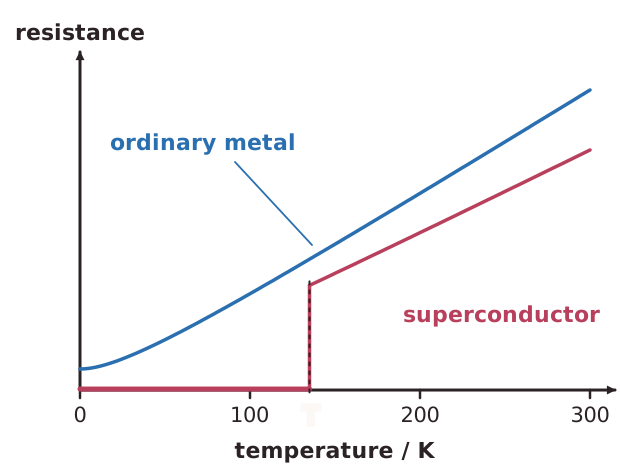 Superconductors are useful when a large current is needed.The large current does not dissipate much heat because there is little or no resistance.Strong electromagnets needed in a particle accelerator such as the LHC utilise superconductors operating at about 1.9K.