Metals consist of a lattice of positive metal ions surrounded by a sea of delocalised electrons.These delocalised electrons are free to move randomly within the lattice. The electrons collide with atoms and other electrons and change direction.The electrons move randomly at speeds of thousands of kilometres per second.When a source of emf is connected to the metal an electric field is set up and the electrons drift slowly towards the positive end of the field.The slow net movement of the electrons at a few mm per second towards the positive terminal is called the drift velocity.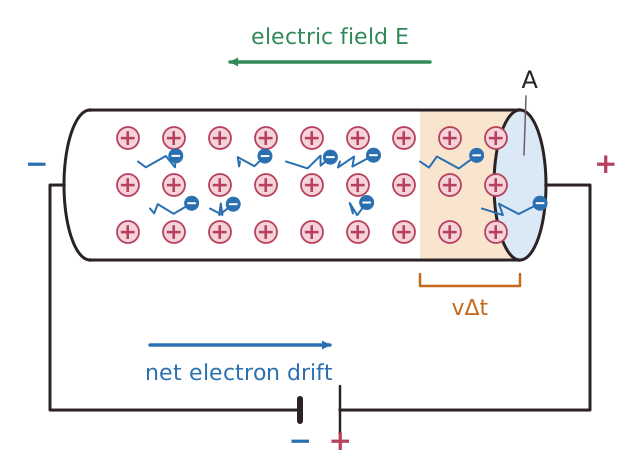 Since current = ΔQ/Δt and there are n electrons per cubic metre of material (number density), the number of electrons will be the number density multiplied by the volume.The total charge will be the number of electrons multiplied by the charge of an electron. In time Δt the electrons move a distance Δx = vΔt along the wire, so the volume containing them is AΔx and ΔQ = nAΔxe.
| I = | ΔQ Δt | = | nAΔxe Δt | = nAve |