The resistance of an emf source is called the internal resistance.
Usually we assume no internal resistance.
When larger currents are used there can be significant power losses. Whenever a current flows, the terminal p.d. is less than the emf (it equals the emf only on open circuit).
If you measure the voltage across the terminals of the power source it would read a certain voltage.
When the current is flowing the voltage reading across the terminals will be less.
The internal resistance acts like a small resistor in series with the cell or power source.
When current flows:
| ε | = | Ir | + | IR |
| emf | | lost volts | | |
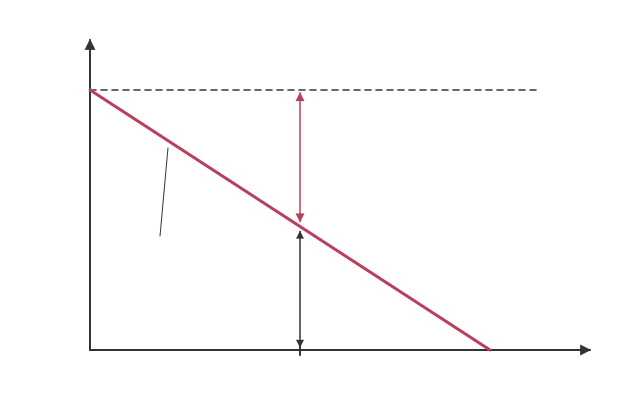
The graph shows how the potential difference across the cell varies with the current.