 BRAINCAKE
Kinetic Energy
Kinetic energy is the energy an object has because of its motion. For an object of mass m moving at speed v, Ek = ½mv2, measured in joules.
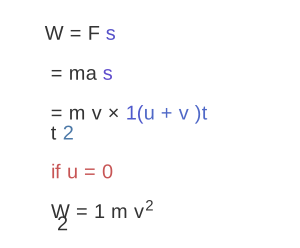
The equation comes from the work done to accelerate the object. A constant force F accelerates a mass from rest over a distance s, so the work done is Fs = mas. Since v2 = 2as for an object starting from rest, the work done is ½mv2, and this is the kinetic energy gained.
Sign in free to see the rest of this lesson, the R.E.C.I.P.E. recall steps and the quiz
BrainCake is free. Make an account in seconds and pick up where this page stops.
More in Work, Energy and Power
- Principle of Conservation of Energy
- Work Done
- Force-Distance Graphs
- Gravitational Potential Energy
- Gravitational-Kinetic Energy Transfers
- Pendulum
- Fairground Ride
- Power
All 21 lessons in Work, Energy and Power · All AQA AS-level Physics topics