A prism can be used to split a beam of white light into colours of the spectrum.This is called dispersion.Each colour is refracted by a different amountViolet light travels more slowly.nviolet light > nred light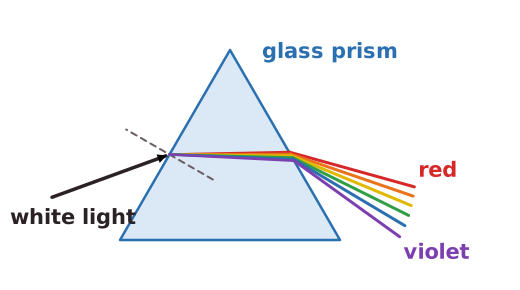
n1 sinθ1 = n2 sinθ2 The amount of bending depends on the angle of incidence and on the ratio of the refractive indices of the two media. Since n = c / cs, violet light, with the larger refractive index, travels more slowly in glass than red light.When light refracts, its speed and wavelength change but its frequency stays the same.In a triangular prism, each colour leaves at a different angle, so the colours spread out into a spectrum. In a parallel-sided glass block, the colours leave parallel to each other and are only slightly displaced sideways.