A velocity-time graph shows direction as well as speed, so velocities in the opposite direction are plotted below the time axis. A speed-time graph never goes below the axis, because speed has no direction.In a velocity-time graph the gradient is the acceleration and the area under the line is the displacement from the starting position. Areas below the time axis count as negative displacement.In a speed-time graph the gradient gives the magnitude of the acceleration and the area under the line is the total distance travelled.
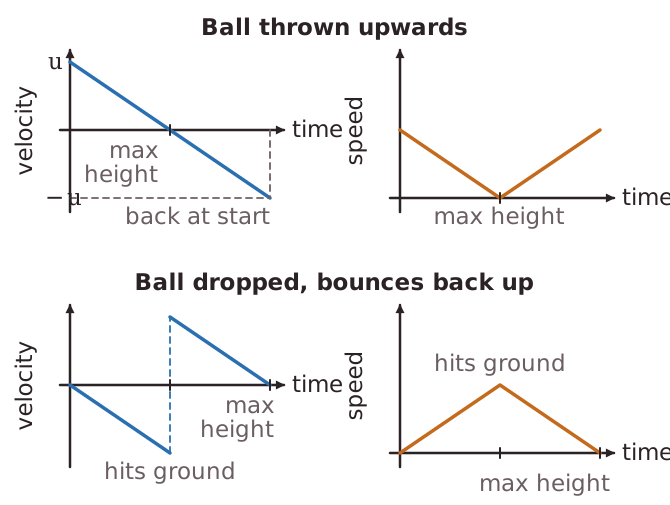
For an object that moves forwards and then back, the total distance is found by adding all the areas as positive values, while the final displacement is found by subtracting the areas below the axis from those above it. For motion in one direction only, the two graphs are identical.
Speed-time vs Velocity-time Graphs
Read the text
Read the text and highlight anything you think is important. When you go on, the text is hidden and you answer from memory.
Specification: AQA Physics (7407), AS-level, 3.4.1.3 Motion along a straight line. Topic: Motion.
Key terms in this lesson
- Resistance
- The ratio of the potential difference across a component to the current flowing through it, measured in ohms.