If a ball is thrown at angle θ, vertically, the projectile undergoes free fall under gravity.Horizontally the projectile travels with constant speed.The resultant motion is a parabolic path. 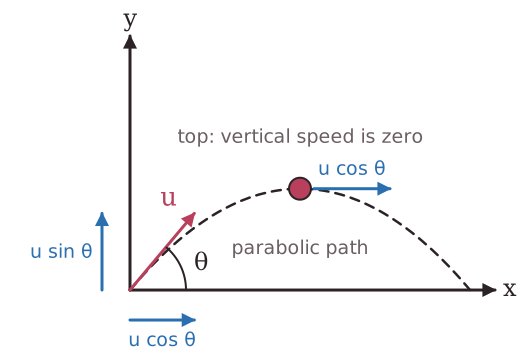
horizontal component = u cosθ vertical component = u sinθ The two components are treated separately. Ignoring air resistance, the horizontal velocity stays constant, while the vertical motion has a constant acceleration of g downwards.The time of flight depends on the vertical height and vertical speed only. Find it using the vertical motion, then use it to find the horizontal distance (range) = u cosθ × t.For example, a ball fired at 12 m s-1 at 30° has a vertical component of 12 sin30° = 6.0 m s-1 and a horizontal component of 12 cos30° = 10.4 m s-1.At the highest point the vertical component of velocity is zero, but the ball is still moving horizontally.
x = ucosθt
y = usinθt - ½gt2