Newton's second law can be written as force = rate of change of momentum, F = Δ(mv)/Δt. Rearranging gives FΔt = Δ(mv). The product of force and the time for which it acts is called the impulse.Impulse equals the change in momentum. Its unit is the newton second (N s), which is equivalent to kg m s-1.
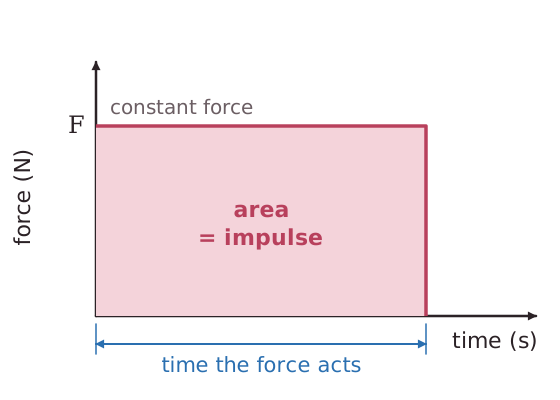
On a graph of force against time, the area under the graph is the impulse, so it gives the change in momentum. This works even when the force changes with time, as in a real collision, where the area can be found by counting squares.Because momentum is a vector, direction matters. If a ball of mass m moving at speed u is hit straight back and leaves at speed v, the change in momentum is m(v + u), not m(v - u).
Force-Time Graphs
Read the text
Read the text and highlight anything you think is important. When you go on, the text is hidden and you answer from memory.
Specification: AQA Physics (7407), AS-level, 3.4.1.6 Momentum. Topic: Force and Momentum.
More in Force and Momentum
- Momentum and Newtons Laws of Motion
- The Rate of Change of Momentum
- Definition of the Newton
- Constant vs Changing Mass
- Force-Time Graphs for Impacts
- Rebound Impacts
- Newton's Third Law of Motion
- The Principle of Conservation of Momentum
All 16 lessons in Force and Momentum · All AQA AS-level Physics topics