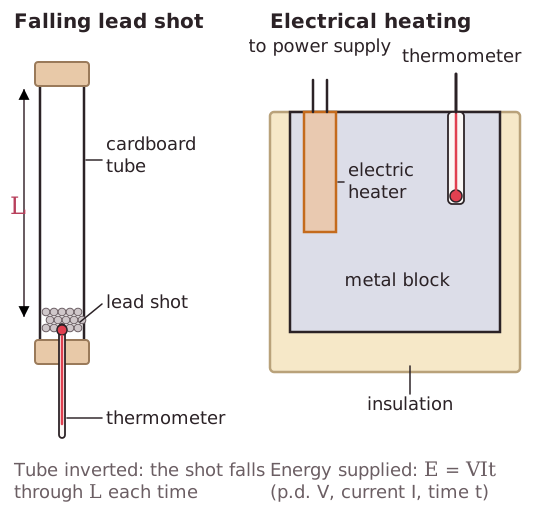
The Specific heat capacity c of a substance is the energy needed to raise the temperature of 1kg of the substance by 1K without a change of state: c = ΔQ/mΔT.The specific heat capacity can be measured by measuring the temperature change when an object freely falls through a distance L under gravity. The difference in gravitational potential energy is transferred to the internal energy of the substance and the temperature of the substance rises.The specific heat capacity can also be measured using electrical energy E = VIt to heat up a block of metal or a calorimeter to heat up liquid. The mass of substance and the initial temperature and final temperature is measured.