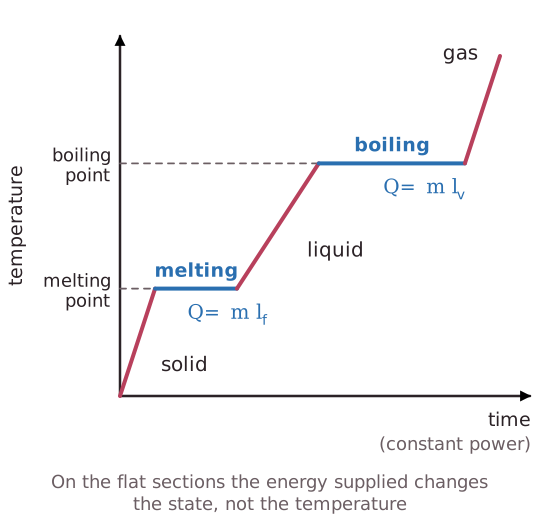
When a solid is heated, its atoms gain kinetic energy, vibrate more as a result the internal energy of the solid increases. At its melting point the temperature does not rise because the energy supplied is used to break the atoms free from each other and turn the solid into a liquid. The energy Q used to melt 1kg of solid without a change in temperature is known as the specific latent heat of fusion lf. Q = mlf (m=mass of solid).When a liquid is heated, its atoms gain kinetic energy. The temperature and internal energy increases. At its boiling point the temperature does not rise. The energy supplied Q is used to break the atoms completely free and liquid turns to gas. The specific latent heat of vaporisation lv is the energy supplied Q to turn 1kg of liquid to gas. Q = mlv where m is the mass of liquid.