Consider an object going round in a circle at uniform speed. The y co-ordinate oscillates between the top and bottom of the circle and is always equal to the radius multiplied by the sine of the angle between the point and the x axis, θ. If the object travels with uniform circular motion, the acceleration = -v2/r = -(2πf)2r.
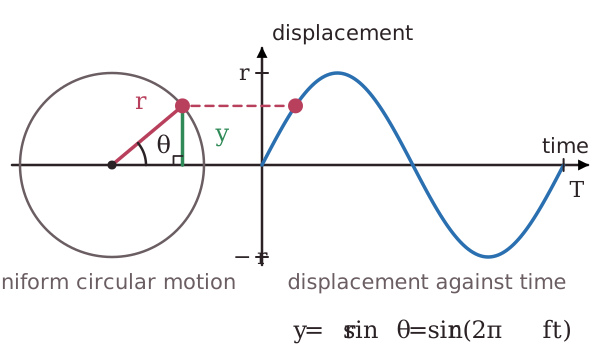
Simple Harmonic Motion and Circular Motion
Read the text
Read the text and highlight anything you think is important. When you go on, the text is hidden and you answer from memory.
Specification: OCR Physics A (H556), A-level, 5.3.2 Energy of a simple harmonic oscillator and 5.3.1 Simple harmonic oscillations. Topic: Simple Harmonic Motion.
More in Simple Harmonic Motion
- Oscillations
- Phase Difference
- Simple Harmonic Motion
- Mass-Spring System
- A Simple Pendulum
- Energy and Simple Harmonic Motion
- Damping
- Resonance
All 9 lessons in Simple Harmonic Motion · All OCR A-level Physics topics