 BRAINCAKE
Simple Harmonic Motion
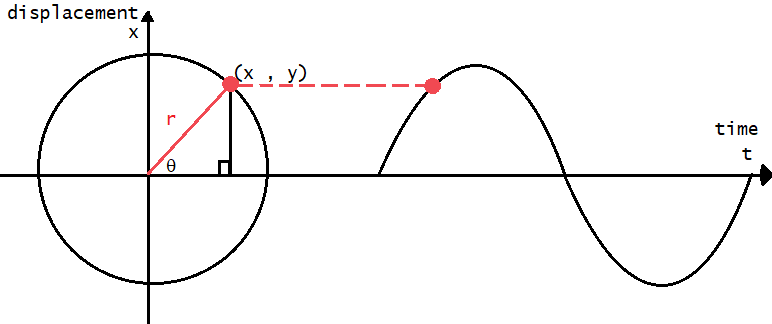
Consider an object going round in a circle at uniform speed. The y co-ordinate oscillates between the top and bottom of the circle and is always equal to the radius multiplied by the sine of the angle between the point and the x axis, θ. If the object travels with uniform circular motion, the acceleration = -v2/r = = (2πf)2r.
Sign in free to see the rest of this lesson, the R.E.C.I.P.E. recall steps and the quiz
BrainCake is free. Make an account in seconds and pick up where this page stops.
Key terms in this lesson
- uniform circular motion
- Motion in a circle at a constant speed, where the direction of velocity continually changes.
More in Simple Harmonic Motion
- Oscillations
- Phase Difference
- Simple Harmonic Motion
- Mass-Spring System
- A Simple Pendulum
- Energy and Simple Harmonic Motion
- Damping
- Resonance
All 9 lessons in Simple Harmonic Motion · All OCR A-level Physics topics