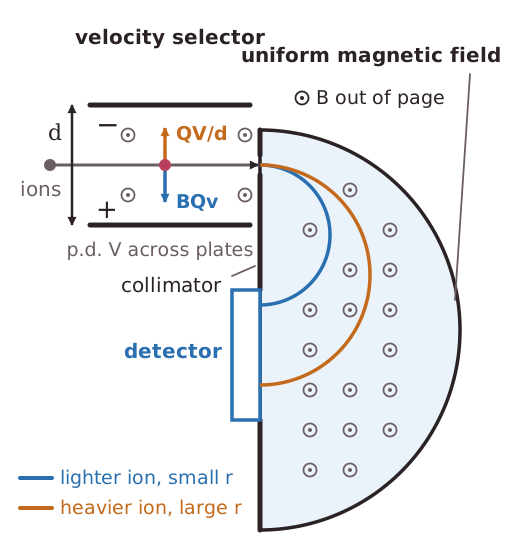
The mass spectrometer separates ions by mass using a velocity selector - a magnet and a pair of parallel plates with a high potential difference. The force due to the electric field F = QV/d is made equal and opposite to the force due to the magnetic field F = BQv so that any ions moving at a particular velocity v where BQv = QV/d are undeflected and can pass through the gap in the collimator. All ions emerge from the collimator with the same speed and enter a magnetic field where they travel a circular path. The radius of the path depends on their mass since r = mv/BQ.