The shuttling ball experiment shows that a current is a flow of charge. A light ball with a conducting coating is hung from an insulating thread between two vertical metal plates, which are connected to a high-voltage supply.
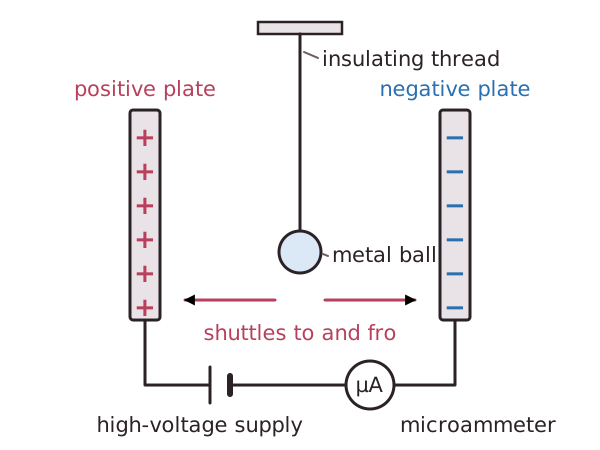
When the ball touches the negative plate, electrons flow onto it and it becomes negatively charged. It is then repelled by the negative plate and attracted towards the positive plate. On touching the positive plate it gives up electrons, becomes positively charged, and is repelled back towards the negative plate.The ball therefore shuttles back and forth, carrying a small charge q across the gap on each crossing. If it makes n crossings per second, the current in the circuit is I = nq, which can be measured with a sensitive ammeter or picoammeter.Increasing the p.d. between the plates increases both the charge on the ball and the force on it, so it shuttles faster and the current increases. Moving the plates closer together increases the field strength E = V/d and has a similar effect.
Shuttling Ball Experiment
Read the text
Read the text and highlight anything you think is important. When you go on, the text is hidden and you answer from memory.
Specification: OCR Physics A (H556), A-level, 6.2.3 Uniform electric field and 6.2.1 Point and spherical charges. Topic: Electric Fields.
Key terms in this lesson
- Coulomb's law
- The force between two point charges is proportional to the product of their charges and inversely proportional to the square of the distance between them.
- alpha radiation
- Ionising radiation consisting of alpha particles, each made of two protons and two neutrons, emitted from an unstable nucleus.
More in Electric Fields
- Static Electricity
- Gold Leaf Electroscope
- Electric Fields
- Electric field strength
- Lightning Conductor
- Electric Field between Two Parallel Plates
- Permittivity of free Space - ε0
- Van de Graaf generator
All 17 lessons in Electric Fields · All OCR A-level Physics topics