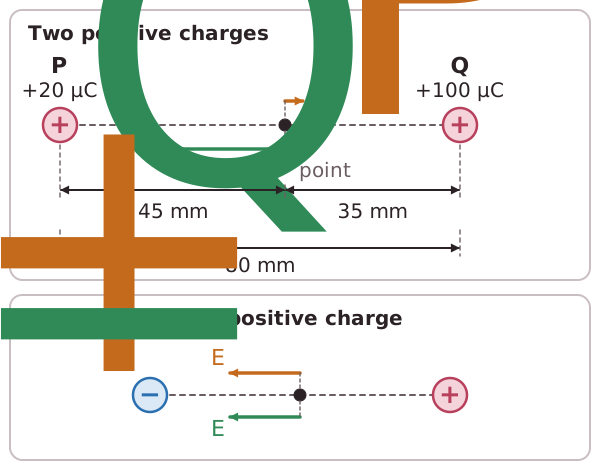
The electric field strength E at a point is the force per unit positive charge acting on a small test charge placed there, E = F/Q. It is measured in N C-1, which is equivalent to V m-1.Electric field strength is a vector. Its direction is the direction of the force on a positive charge, so it points away from a positive point charge and towards a negative point charge.For an isolated point charge Q, combining E = F/Q with Coulomb's law gives E = Q/(4πε0r2). The field is radial and obeys an inverse square law, so doubling the distance reduces E to one quarter.When there are two or more point charges, the resultant field strength at a point is the vector sum of the fields due to each charge. Work out each field separately, give it a direction, and then add them, taking account of direction.For example, midway between two equal positive charges the two fields are equal in size and opposite in direction, so the resultant field strength is zero. Between a positive and a negative charge the two fields point the same way, so they add.