 BRAINCAKE
Rutherford's α-Particle Scattering Experiment.
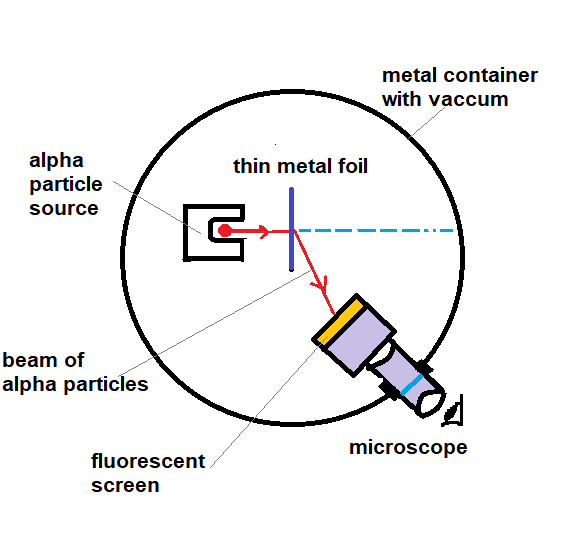
In 1911, Ernest Rutherford carried out an experiment to probe the atom. He directed a narrow beam of α-particles all with the same kinetic energy at a thin gold foil only a few atoms thick. The alpha particles were detected by a detector which could be moved around at a fixed distance from where the alpha particle beam hit the metal foil. A microscope was used to observe the point of light emitted by the α-particles hitting a fluorescent screen.
Sign in free to see the rest of this lesson, the R.E.C.I.P.E. recall steps and the quiz
BrainCake is free. Make an account in seconds and pick up where this page stops.
More in Radioactivity
- Rutherford's Interpretation
- Radioactivity
- Radioactivity Observations
- Geiger Tube
- The nature of α, β and γ Radiation.
- Gamma radiation
- Radioactive Change
- The Dangers of Radioactivity
All 25 lessons in Radioactivity · All Edexcel A-level Physics topics