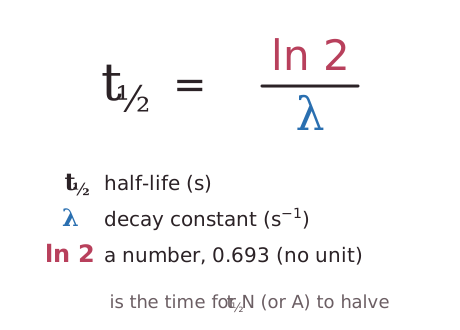
The decay constant λ is the probability of an individual nucleus decaying per second. The half-life is related to the decay constant.t½ = ln 2 / λ λ has the unit s-1 (it can also be given per hour or per year). A large decay constant means each nucleus is more likely to decay in a given second, so the isotope decays quickly and has a short half-life.The activity A of a sample (the number of decays per second, in becquerels) is proportional to the number of undecayed nuclei N:A = λN Because the rate of decay is proportional to N, the number of undecayed nuclei falls exponentially with time:N = N0e−λt The activity follows the same pattern, A = A0e−λt. Putting N = N0/2 at t = t½ gives e−λt½ = ½, so λt½ = ln 2, which is where t½ = ln 2/λ comes from.Example: the activity of a sample falls from 40 kBq to 32 kBq in 48 hours. Then e−λt = 0.80, so λ = ln 1.25 ÷ (48 × 3600 s) = 1.3 × 10⁻⁶ s-1, and t½ = ln 2/λ = 149 hours.