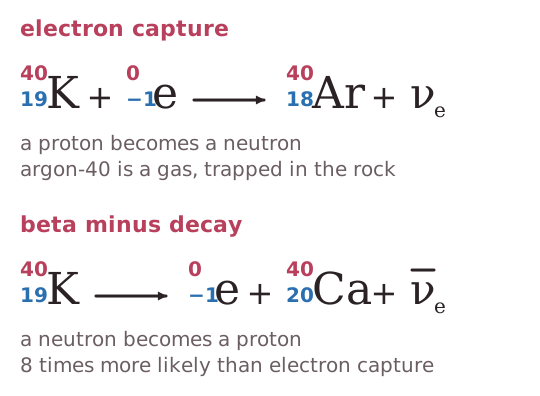
Potassium-40 in rocks undergoes electron capture and changes to argon-40 and a neutrino. The argon-40 is trapped in the rocks. Potassium-40 also decays by beta emission to form Calcium-40. The probability of potassium decaying to calcium is 8x greater than the probability of electron capture The overall half-life of potassium-40, taking both types of decay into account, is 1250 million years. The age of the rock can then be calculated by measuring the proportion of argon-40 to potassium-40 in the rock.