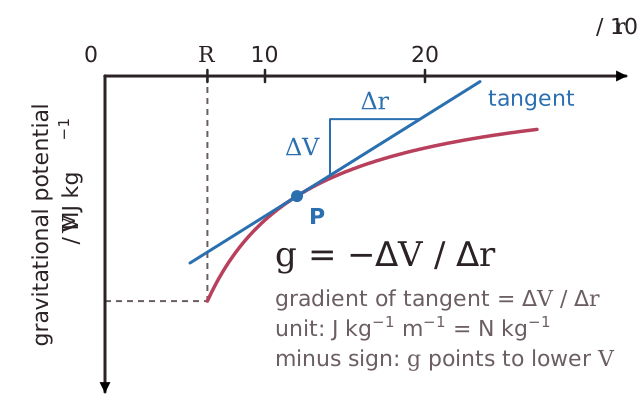
The gradient of the tangent at any point on the gravitational potential curve is equal to the gravitational potential gradient.The gravitational potential gradient is the change in gravitational potential per metre, ΔVgrav/Δr. It is linked to the gravitational field strength by:g = −ΔVgrav/Δr The minus sign is there because gravitational potential is zero at infinity and negative everywhere else. Moving away from a planet, Vgrav rises towards zero, so the gradient is positive, while g points the other way, towards the planet. The field strength is the negative of the potential gradient.For a planet of mass M, Vgrav = −GM/r. The gradient of this curve at a distance r has size GM/r2, which is exactly the magnitude of g. The curve is steep close to the planet, where the field is strong, and flattens out far away, where the field is weak.The units agree: J kg-1 m-1 is the same as N kg-1, because 1 J = 1 N m.Example: at the surface of the Moon (radius 1.74 × 10⁶ m) the potential gradient is 1.62 N kg-1. Since GM/r2 = 1.62, the mass of the Moon is M = 1.62 × (1.74 × 106)2 ÷ (6.67 × 10⁻¹¹) = 7.35 × 10²² kg.