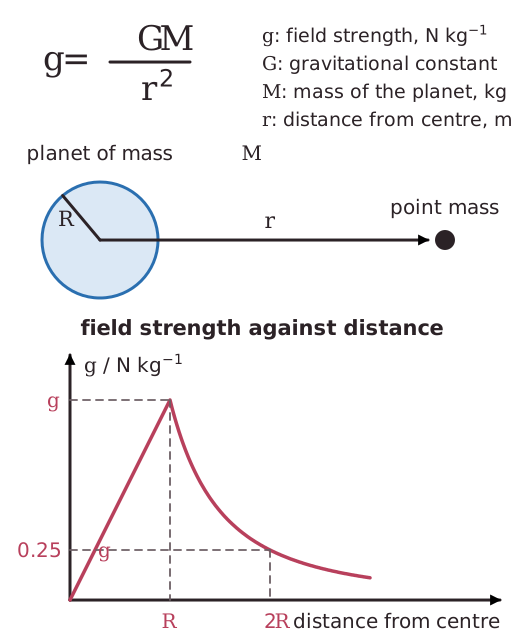
Newton's law of gravitation can be applied to the gravitational field strength g = F/m.For a point mass in the gravitational field of a spherical planet, a distance r > R (radius of the sphere):g = GM/r2 This comes from setting the gravitational force on a small test mass m equal to its weight: F = GMm/r2 = mg, so the test mass cancels. G = 6.67 × 10⁻¹¹ N m2 kg-2, M is the mass of the planet and r is the distance from the centre of the planet. The gravitational field strength at a point is the force per unit mass on a small test mass placed there, measured in N kg-1. It is a vector that points towards the centre of the planet.Outside the planet g follows an inverse square law. At the surface (r = R) it has its largest value, g0 = GM/R2. At 2R from the centre g falls to g0/4.Inside a planet of uniform density, only the mass nearer the centre than the point contributes, so g increases linearly from zero at the centre to g0 at the surface.For the Earth, M = 6.0 × 1024 kg and R = 6.4 × 10⁶ m, so g0 = (6.67 × 10-11 × 6.0 × 1024) ÷ (6.4 × 10⁶)2 = 9.8 N kg-1.