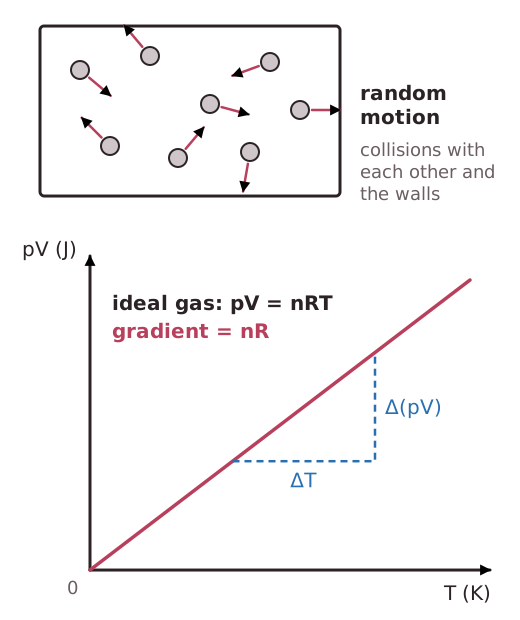
Smoke particles may be illuminated and observed under a microscope. The particles move with a rapid random motion called Brownian motion. The smoke particles are continually hit by the much smaller, invisible air molecules, which makes them change direction.Avogadro's hypothesis states that equal volumes of gases at the same temperature and pressure have the same number of molecules: NA = 6.02 × 10²³ molecules which is the number of atoms in 12g of Carbon-12. This number is the Avogadro constant, and this amount of substance is one mole and the mass of one mole of a substance is called the molar mass.An ideal gas obeys Boyle's law, Charles' law and the pressure law exactly. Combining Boyle's, Charles' and the Pressure Laws: pV = nRT (the ideal gas equation) where n is the number of moles and the molar gas constant R=8.31Jmol-1K-1 and T is in kelvin.