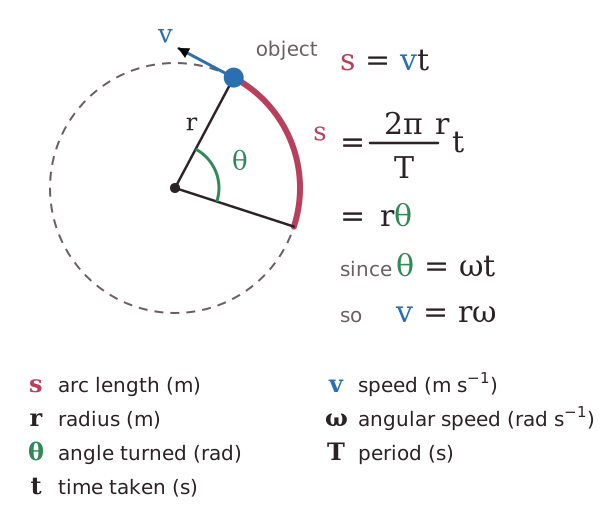
The angular speed ω is defined as the angular displacement per second.ω = 2π/T = 2πf The unit of angular speed is radians per second.For an object moving in a circle, the angular displacement θ (in radians) swept out in a time t gives the angular speed ω = θ/t. One complete revolution is an angular displacement of 2π radians and takes one time period T, which is why ω = 2π/T. Since the frequency f = 1/T is the number of revolutions per second, this can also be written ω = 2πf.Angular speed is linked to the linear speed v of the object along the circle. In one revolution the object travels the circumference 2πr in a time T, so v = 2πr/T, which gives:v = ωr Every point on a rigid rotating wheel has the same angular speed, but points further from the axle have a greater linear speed. For example, a wheel turning 5 times per second has ω = 2π × 5 = 10π rad s-1 (about 31 rad s-1). A bicycle travelling at 12 m s-1 on wheels of radius 0.4 m has wheels turning at ω = v/r = 12/0.4 = 30 rad s-1.Angles must be in radians, not degrees, when using these equations.