The electric field surrounding point charges are radial and is equal to kQ/r2 at a distance r from Q.The electric potential near a point charge is V = kQ/r.The electric potential V at a point is the work done per unit charge in bringing a small positive test charge from infinity to that point. It is measured in volts (1 V = 1 J C-1). For a point charge Q at a distance r:V = Q/4πε0r and the field strength is E = Q/4πε0r2, where 1/4πε0 = 8.99 × 10⁹ N m2 C-2. The sign of V comes from the sign of Q: the potential is positive near a positive charge, because work must be done to push a positive test charge towards it, and negative near a negative charge. In both cases V is zero at infinity.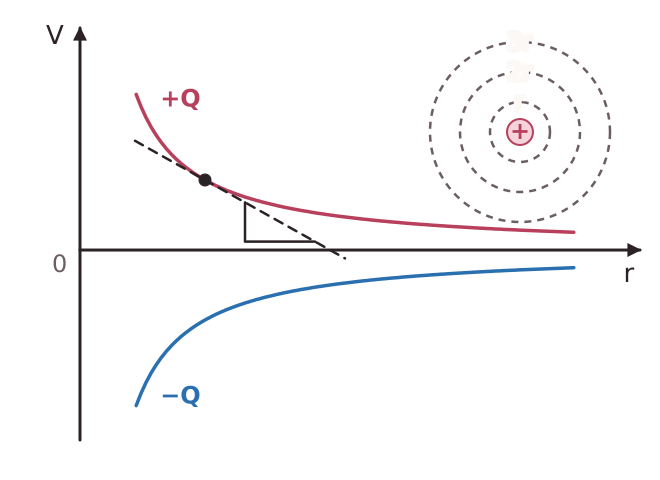 Electric potential is a scalar, so the potential due to several charges is found by adding their potentials, taking account of their signs. For example, 10 mm from a +15 μC charge and 20 mm from a −30 μC charge, V = (15 × 10-6 ÷ 0.010 − 30 × 10-6 ÷ 0.020)/4πε0 = 0.Field and potential are linked by E = −ΔV/Δr. Between parallel plates with a potential difference V and separation d the field is uniform, with E = V/d.