The electric field strength is a vector quantity. Consider two point charges placed a distance d apart. The electric field strength is the vector sum of the electric field strengths of the two point charges.For a single point charge Q, the field strength at a distance r is:E = Q/4πε0r2 where 1/4πε0 = 9.0 × 10⁹ N m2 C-2. The field points away from a positive charge and towards a negative charge.To find the resultant field at a point near two charges:
1. Calculate the size of E due to each charge on its own.
2. Work out the direction of each field at that point.
3. Add the two fields as vectors. On the line joining the charges, fields in the same direction add and fields in opposite directions subtract. Otherwise use a vector diagram.Example: a +20 μC charge P and a +100 μC charge Q are 80 mm apart. At a point 45 mm from P and 35 mm from Q, the field due to P is 8.9 × 10⁷ N C-1 towards Q and the field due to Q is 7.35 × 10⁸ N C-1 towards P. They act in opposite directions, so the resultant is 7.35 × 10⁸ − 0.89 × 108 = 6.46 × 10⁸ N C-1 towards P.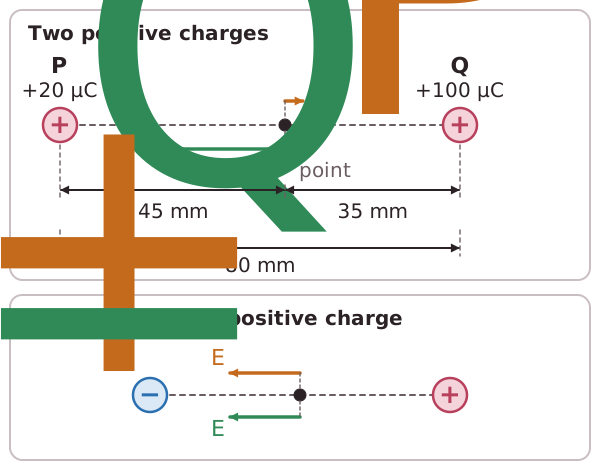 Between two like charges there is a neutral point where the two fields cancel and E = 0.
1. Calculate the size of E due to each charge on its own.
2. Work out the direction of each field at that point.
3. Add the two fields as vectors. On the line joining the charges, fields in the same direction add and fields in opposite directions subtract. Otherwise use a vector diagram.Example: a +20 μC charge P and a +100 μC charge Q are 80 mm apart. At a point 45 mm from P and 35 mm from Q, the field due to P is 8.9 × 10⁷ N C-1 towards Q and the field due to Q is 7.35 × 10⁸ N C-1 towards P. They act in opposite directions, so the resultant is 7.35 × 10⁸ − 0.89 × 108 = 6.46 × 10⁸ N C-1 towards P.
Between two like charges there is a neutral point where the two fields cancel and E = 0.