 BRAINCAKE
Simple Harmonic Motion and Circular Motion
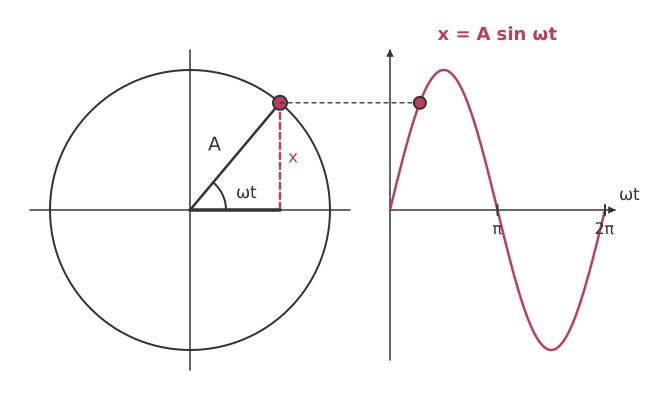
Consider an object going round in a circle at uniform speed.
The y co-ordinate oscillates (with simple harmonic motion) between the top and bottom of the circle and is always equal to the radius multiplied by the sine of the angle between the point and the x axis, θ.
If the object travels with uniform circular motion, the acceleration is equal to -v2/r and since v = rω then acceleration is given by
a = -ω2r
which is the equation for SHM.
At any time t the displacement is given by
x = A sin ωt
where A is the amplitude, because ωt is the phase or part of the cycle it is in.