 BRAINCAKE
Type Ia Supernovae as Standard Candles
A type Ia supernova happens in a binary system containing a white dwarf and a companion star. The white dwarf pulls matter from its companion. When its mass exceeds about 1.4 solar masses (the Chandrasekhar limit), runaway fusion begins and the white dwarf explodes completely.
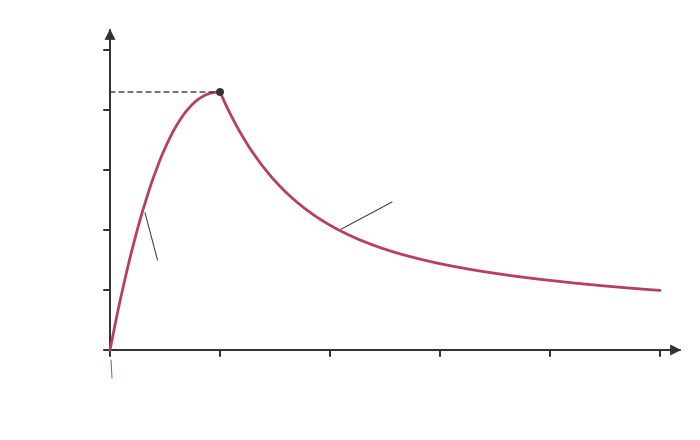
Because every type Ia supernova explodes at the same mass, they all reach the same peak absolute magnitude, about M = −19.3. An object of known absolute magnitude is called a standard candle. They are so bright that they can be seen in very distant galaxies.
Sign in free to see the rest of this lesson, the R.E.C.I.P.E. recall steps and the quiz
BrainCake is free. Make an account in seconds and pick up where this page stops.
Key terms in this lesson
- dark energy
- A hypothesised form of energy that is thought to be responsible for the observed acceleration in the rate of expansion of the universe.
More in Astrophysics
- The Hertzsprung-Russell Diagram
- Evolution of a Star
- Supernovae, Neutron Stars and Black Holes
- The Schwarzschild Radius
- The Doppler Effect and Red Shift
- Hubble's Law
- The Big Bang Theory and the Age of the Universe
- Quasars
All 24 lessons in Astrophysics · All AQA A-level Physics topics