 BRAINCAKE
Detecting Exoplanets
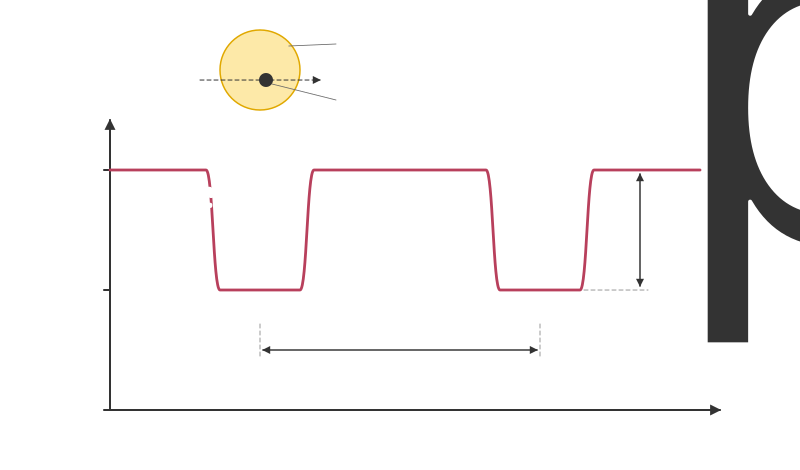
An exoplanet is a planet orbiting a star other than the Sun. Thousands have now been found, but very few have been seen directly, because:
• a planet emits no light of its own and only reflects a tiny fraction of its star's light
• the planet is very close to its much brighter star as seen from Earth, so its light is swamped by the star's glare
Two indirect methods are used.
Radial velocity method. The star and planet both orbit their common centre of mass, so the star wobbles slightly. As it moves towards and away from us, the lines in its spectrum are periodically blue shifted and red shifted (the Doppler effect). The period of the variation equals the planet's orbital period, and a larger shift indicates a more massive planet. This method works best for massive planets close to their stars.
Sign in free to see the rest of this lesson, the R.E.C.I.P.E. recall steps and the quiz
BrainCake is free. Make an account in seconds and pick up where this page stops.
Key terms in this lesson
- doppler effect
- The change in the observed frequency or wavelength of waves that occurs when there is relative motion between the source of the waves and the observer.
More in Astrophysics
- Evolution of a Star
- Supernovae, Neutron Stars and Black Holes
- The Schwarzschild Radius
- Type Ia Supernovae as Standard Candles
- The Doppler Effect and Red Shift
- Hubble's Law
- The Big Bang Theory and the Age of the Universe
- Quasars
All 24 lessons in Astrophysics · All AQA A-level Physics topics