Skip to content

Condensation

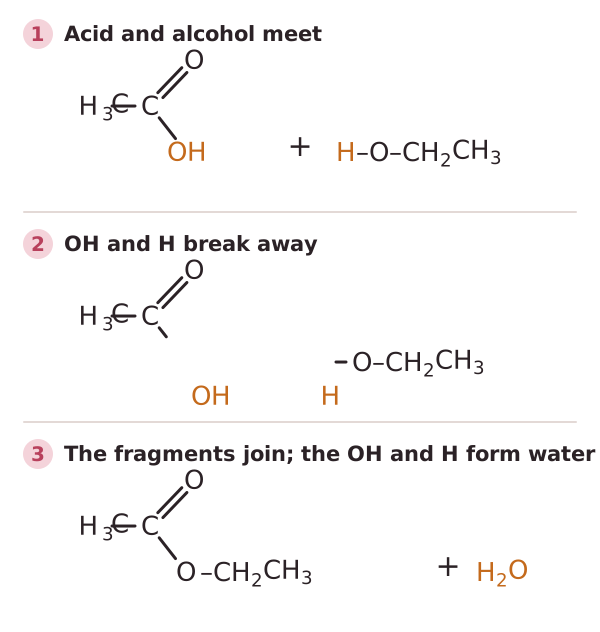
In a condensation reaction two molecules join together and a small molecule, usually water or hydrogen chloride, is removed.Esterification is a condensation reaction. A carboxylic acid reacts with an alcohol, using concentrated sulfuric acid as a catalyst, to form an ester and water. Ethanoic acid and ethanol form ethyl ethanoate.Esterification is reversible, so an equilibrium mixture forms and the ester has to be separated, for example by distillation.When each monomer has two functional groups, condensation can happen repeatedly to form condensation polymers such as polyesters and polyamides.
Read the text

Read the text and highlight anything you think is important. When you go on, the text is hidden and you answer from memory.

Specification: OCR Chemistry A (H432), A-level, 4.2.1 Alcohols and 4.1.3 Alkenes. Topic: Reactions and Reactive Species.

Key terms in this lesson

esterification
The reaction of a carboxylic acid, or an acid anhydride, with an alcohol, in the presence of an acid catalyst, to form an ester.
polyester
A condensation polymer formed from monomers with carboxyl and hydroxyl groups, joined by ester linkages.
polyamide
A condensation polymer formed from monomers with carboxyl and amine groups, joined by amide (peptide) linkages.

More in Reactions and Reactive Species

All 20 lessons in Reactions and Reactive Species · All OCR A-level Organic Chemistry topics