 BRAINCAKE
Addition and Condensation Polymerisation
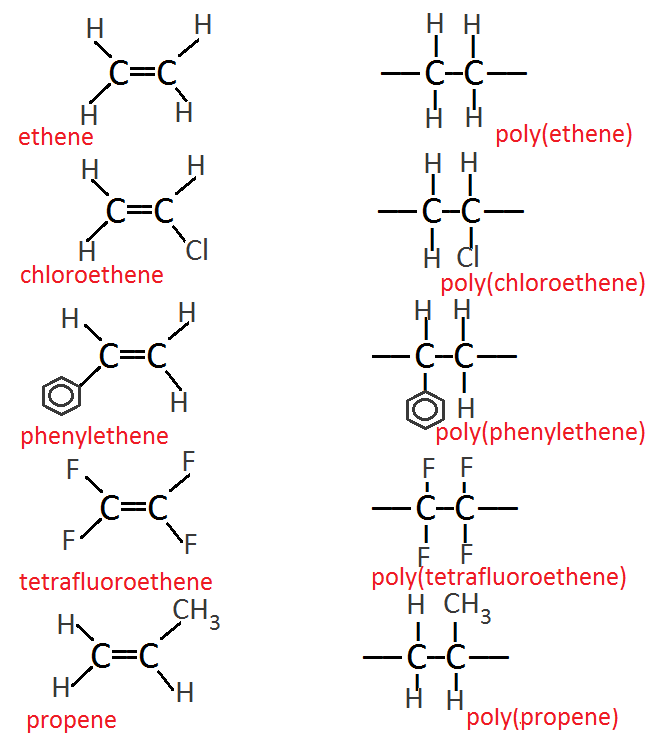
Addition polymers are made from monomers with C=C double bonds. The monomer is based on ethene. The double bond opens and the monomers bond together to form a backbone of carbon atoms. There is usually only one monomer but it is possible to have more than one different monomer.
Polyalkenes are non-polar and unreactive. As a result they are not attacked by biological agents such as enzymes so are not biodegradable.
Sign in free to see the rest of this lesson, the R.E.C.I.P.E. recall steps and the quiz
BrainCake is free. Make an account in seconds and pick up where this page stops.
Key terms in this lesson
- hydrolysis
- The breaking of a covalent bond by reaction with water, or with hydroxide ions in alkaline hydrolysis.
- polyester
- A condensation polymer formed from monomers with carboxyl and hydroxyl groups, joined by ester linkages.
- polyamide
- A condensation polymer formed from monomers with carboxyl and amine groups, joined by amide (peptide) linkages.
More in Polymers
All 3 lessons in Polymers · All OCR A-level Organic Chemistry topics