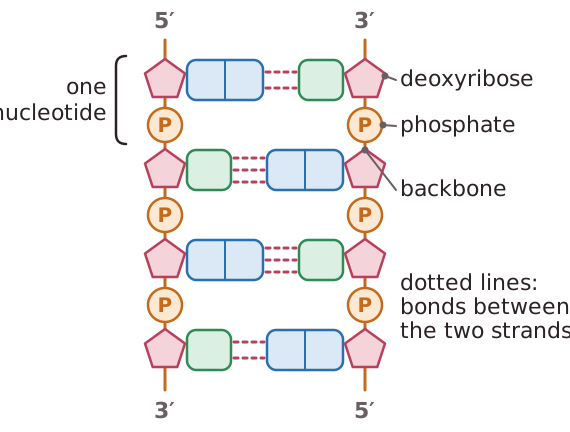
DNA is a natural condensation polymer. Its monomers are nucleotides, and each nucleotide is made of a deoxyribose sugar, a phosphate group and a nitrogen-containing base.Nucleotides join by condensation reactions between the phosphate of one nucleotide and the sugar of the next, with water removed. This forms a sugar-phosphate backbone.There are four bases: adenine (A), thymine (T), cytosine (C) and guanine (G). Two strands are held together by hydrogen bonds between complementary base pairs, A with T and C with G.The two strands twist to form a double helix. Like other condensation polymers, DNA can be broken down by hydrolysis.