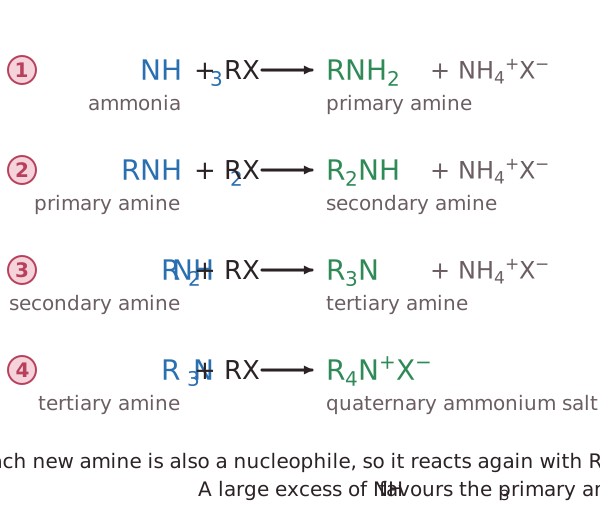
When ammonia in an ethanol solvent reacts with a halogenoalkane a primary amine is produced by the nucleophilic substitution of the halide by an NH2 group. However, the primary amine produced is also a nucleophile and in turn reacts with the halogenoalkane to form a secondary amine.The secondary amine reacts to form a tertiary amine and the tertiary amine reacts to form a quaternary ammonium salt.The nucleophilic substitution reaction of ammonia and a halogenoalkane is not a very efficient way of preparing an amine because of the further substitutions. The ammonia in a large excess will give a better yield of the primary amine.
Reactions of Amines as Nucleophiles
Read the text
Read the text and highlight anything you think is important. When you go on, the text is hidden and you answer from memory.
Specification: OCR Chemistry A (H432), A-level, 6.2.1 Amines. Topic: Nitrogen Compounds.
Key terms in this lesson
- nucleophile
- An atom or group of atoms that can donate a pair of electrons to form a new covalent bond.
- nucleophilic substitution
- A reaction mechanism in which a nucleophile donates a lone pair of electrons to an electron-deficient carbon atom, displacing a leaving group.
More in Nitrogen Compounds
- Amines
- Properties of Amines
- Basicity of Amines
- Synthesis of Amines
- Reactions of Amines as Bases
- Economic Importance of Amines
All 7 lessons in Nitrogen Compounds · All OCR A-level Organic Chemistry topics