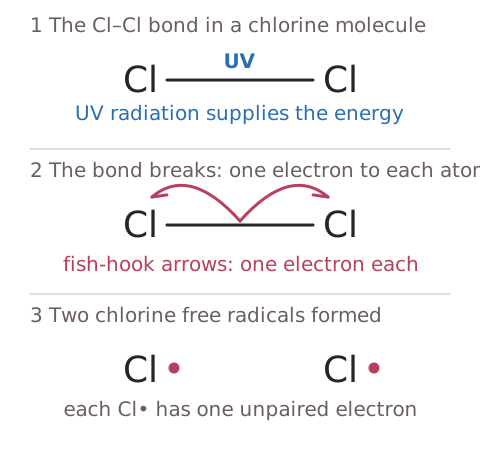
In homolytic fission a covalent bond breaks and each atom takes one of the two bonding electrons.This forms two radicals. A radical is a species with an unpaired electron, shown by a dot, for example Cl•. Radicals are very reactive.The energy to break the bond is often supplied by ultraviolet radiation. For example, UV light splits chlorine molecules: Cl2 → 2Cl•. This is the initiation step of free radical substitution.Homolytic fission usually happens in non-polar bonds, where both atoms have similar electronegativities. The movement of a single electron is shown with a half-headed, fish-hook arrow.