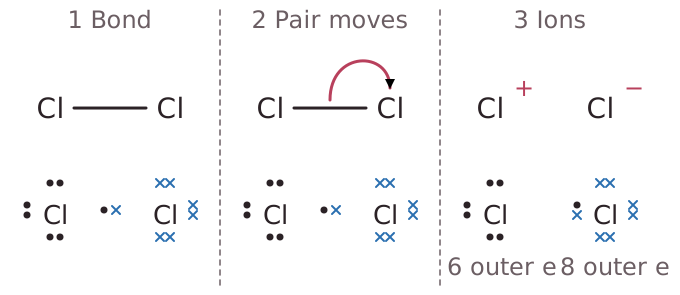
In heterolytic fission a covalent bond breaks and both bonding electrons go to the same atom.The atom that takes both electrons becomes a negative ion, and the other atom becomes a positive ion. So heterolytic fission forms two oppositely charged ions.It usually happens in polar bonds, where the electrons go to the more electronegative atom. For example, in C-Br the electrons go to bromine, forming a bromide ion and a carbocation.A non-polar molecule such as Br2 can also break heterolytically if it is polarised by a nearby electron-rich species. The movement of the electron pair is shown with a double-headed curly arrow.