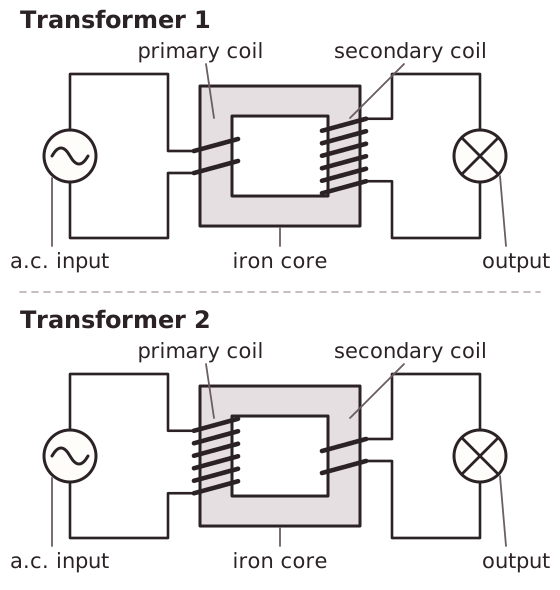
A transformer changes the potential difference of an alternating current (a.c.) supply. It has a primary coil and a secondary coil wound on an iron core. Transformers only work with alternating current.
A step-up transformer increases the potential difference. One is used as power leaves a power station, so electricity travels along the cables at high voltage. A step-down transformer reduces the potential difference. These are used near homes, in each locality, to bring the voltage down for domestic use.
In an ideal transformer the power in equals the power out: primary p.d. (V) × primary current (A) = secondary p.d. (V) × secondary current (A). So when the p.d. is stepped up, the current falls. For example, 12 V and 5 A going in gives 60 W, so a secondary of 120 V has a current of 0.5 A. The higher voltage means the current falls, so less energy is wasted as heat in the cables.