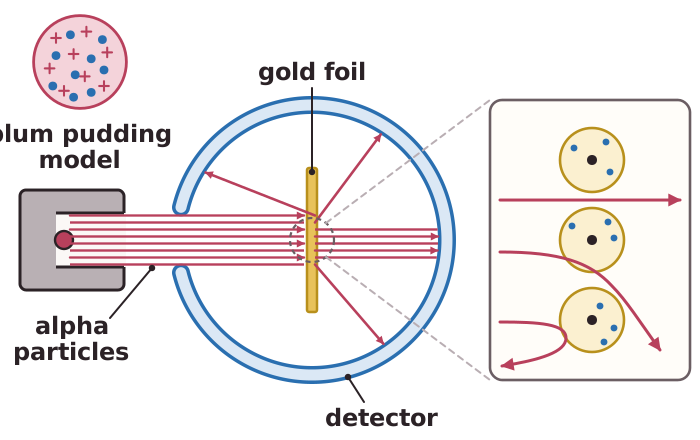
Scientists change a model when new evidence does not fit it. After J.J. Thomson discovered the electron, he suggested the plum pudding model: the atom is a ball of positive charge with tiny negative electrons embedded in it, like plums in a pudding.
Rutherford and his team fired alpha particles at a very thin sheet of gold foil. The plum pudding model predicted that they would pass through with only small deflections. Most did go straight through, but a few were deflected through large angles and a very small number bounced back.
This showed that the atom is mostly empty space, with a tiny, dense nucleus at the centre that holds most of the mass and has a positive charge. Alpha particles are positive, so they are repelled by the nucleus. This is the nuclear model. Niels Bohr then suggested that the electrons orbit the nucleus at fixed distances in energy levels, which agreed with further experimental evidence.