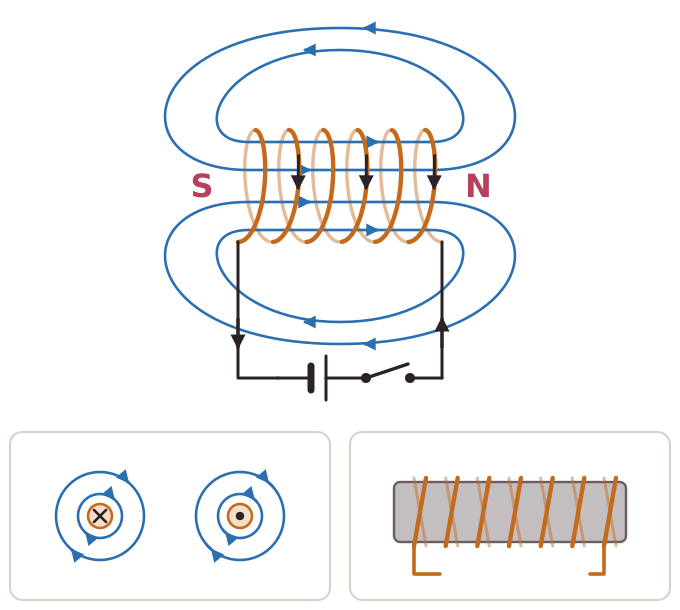
A solenoid is a long coil of wire. When a current flows, each turn of the wire makes its own circular magnetic field. A solenoid is an example of an electromagnet, because it is magnetic only while the current flows.
Inside the coil, the fields from the individual turns point in the same direction, so they add together. This gives a very strong, almost uniform field along the centre of the solenoid. Almost uniform means the field has nearly the same strength and direction at every point there.
Outside the solenoid, the fields from different turns point in opposite directions and mostly cancel, giving a much weaker field. The overall pattern outside looks like that of a bar magnet, with a north pole at one end and a south pole at the other.
The field can be made stronger by using more turns of wire, a bigger current, or a piece of iron inside the coil as a core.