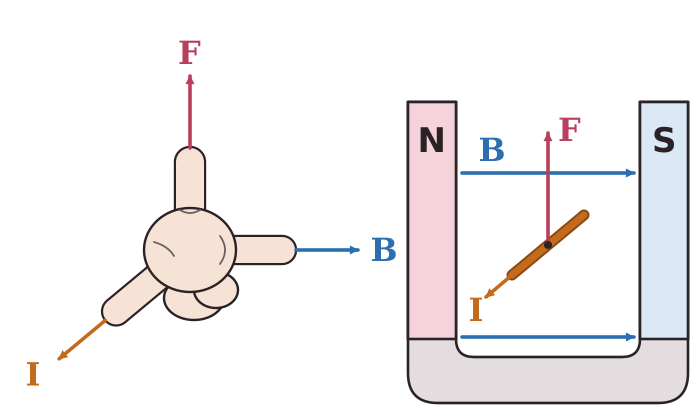
When a conductor carrying a current is placed in a magnetic field, the magnet producing the field and the conductor exert a force on each other. This is called the motor effect. The current in the wire has its own magnetic field, and this interacts with the field of the magnet to give a force on the wire.
Fleming's left-hand rule shows how the force, the current and the magnetic field are oriented. Hold your left thumb, first finger and second finger at right angles to each other. The first finger points in the direction of the magnetic field (north to south), the second finger points in the direction of the current, and the thumb shows the direction of the force on the conductor. The thumb is the motion.
The size of the force depends on the magnetic flux density, the current and the length of conductor in the field. For a conductor at right angles to the field, F = B I l, where F is the force in newtons (N), B is the magnetic flux density in tesla (T), I is the current in amperes (A) and l is the length of conductor in the field in metres (m). For example, B = 0.2 T, I = 3 A and l = 0.5 m gives F = 0.2 × 3 × 0.5 = 0.3 N.