A gamete is a sex cell. The nucleus contains chromosomes, and a gene is a section of a chromosome that controls a characteristic. Some characteristics are controlled by a single gene, such as fur colour in mice and red-green colour blindness in humans. Each gene can have different forms, called alleles. Most characteristics are controlled by many genes working together, not by a single gene.
The alleles an organism has are its genotype. The characteristic they produce is its phenotype. A dominant allele is always expressed, even if only one copy is present. A recessive allele is only expressed if two copies are present, which means there is no dominant allele. If the two alleles are the same, the organism is homozygous for that trait. If the alleles are different, it is heterozygous.
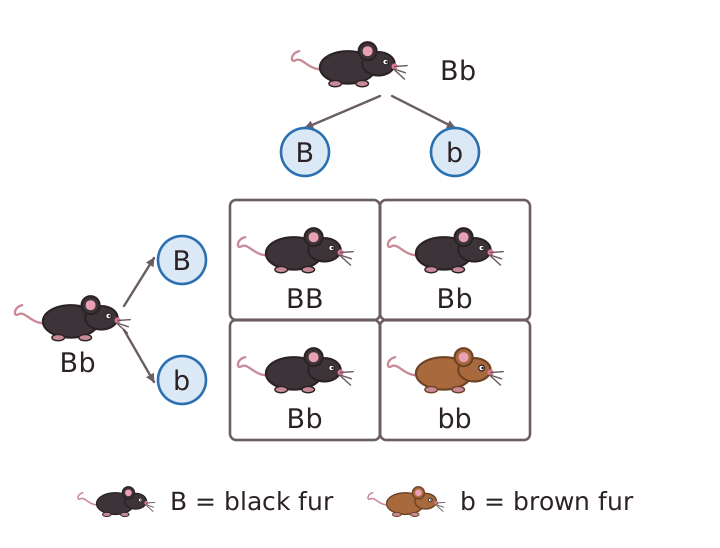
A Punnett square shows the possible outcomes of a cross as probabilities. Take mice where B (black fur) is dominant and b (brown fur) is recessive. Two heterozygous parents, Bb and Bb, give offspring BB, Bb and bb in the ratio 1 : 2 : 1. The chance of a brown mouse (bb) is 1 in 4, or 25%. A probability is only a chance, so the real numbers of offspring may differ.