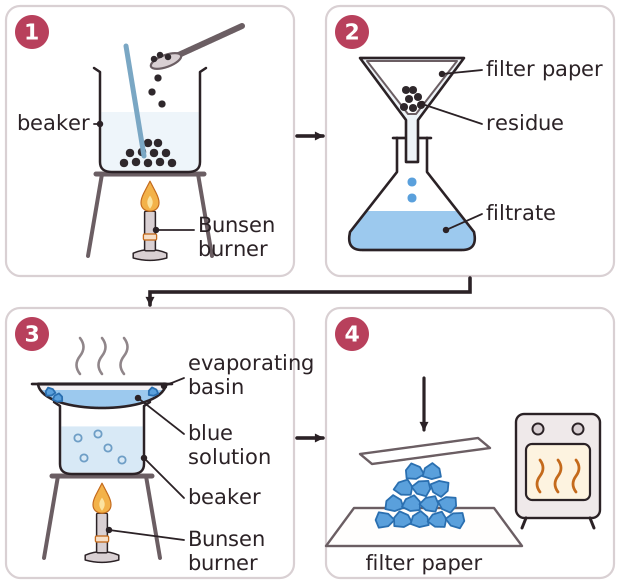
A soluble salt can be made by reacting an acid with a solid that does not dissolve in water, such as a metal, a metal oxide, a metal hydroxide or a metal carbonate. The solid is added to the acid until no more reacts. The leftover solid is the excess, and it is removed by filtering. This leaves a solution of the salt.
This is required practical 8, making a pure, dry sample of copper sulfate from copper oxide. Warm some dilute sulfuric acid in a beaker, heating it gently with a Bunsen burner. Add copper oxide a little at a time and stir. Keep adding until some black solid stays at the bottom, which shows that all the acid has been used up. Filter off the excess copper oxide. The filtrate is a blue solution of copper sulfate.
Next, pour the solution into an evaporating basin and heat it gently over a water bath or with an electric heater to evaporate some of the water. Stop heating when crystals start to form at the edge, then leave the solution to cool so that it can crystallise. Filter off the crystals and dry them between filter papers or in a warm oven.
Adding the solid in excess is important. Because the solid is insoluble, you can see when it is in excess, and filtering takes it away, so the salt is not contaminated with acid.