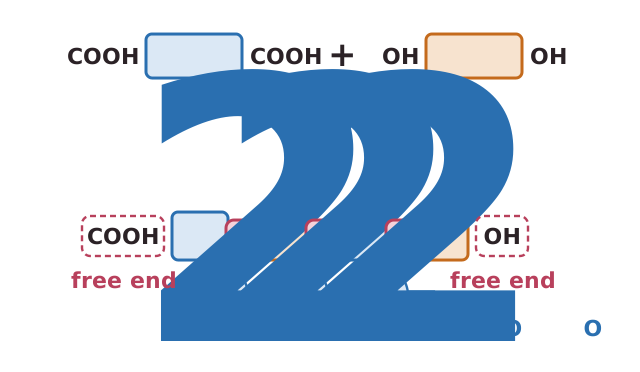
Polyesters are not made from alkenes. They are made from two different monomers. One monomer has two carboxylic acid groups (-COOH), one at each end, so it is a dicarboxylic acid. The other has two alcohol groups (-OH), one at each end, so it is a diol.
A carboxylic acid group reacts with an alcohol group to form an ester link, -COO-. Each time an ester link forms, a small molecule of water is made as well, using an -OH from the acid and an H from the alcohol. Because a small molecule is lost each time a link forms, this is called condensation polymerisation. This is different from addition polymerisation, where nothing is lost and there is only one product.
Each monomer has a reactive group at both ends, so the chain can keep growing in both directions, with the two monomers alternating along it. Joining monomers end to end makes one link between each neighbouring pair. So a chain of n monomers has n - 1 ester links, and n - 1 water molecules are released, one for each link. For example, a chain of five monomers has four ester links, and four water molecules are released.