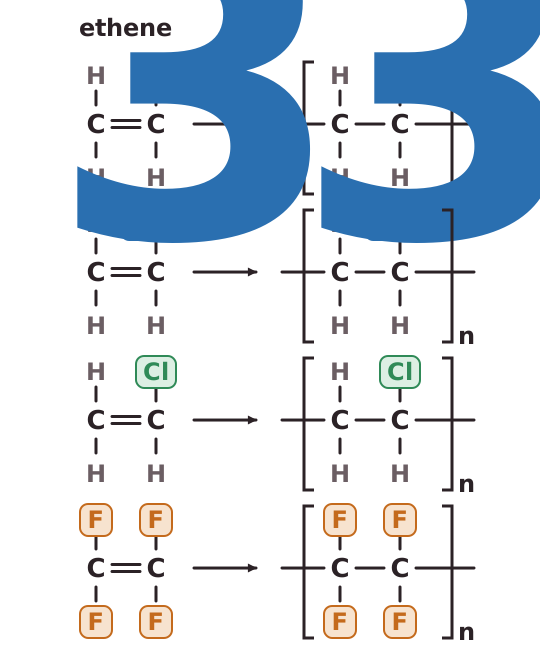
An addition polymer is drawn as its repeating unit in brackets with a small n after them. When the monomer is an alkene, the chain of the polymer is made only of carbon atoms, and each repeating unit has two carbon atoms in the chain. These two carbons are the two that were joined by the C=C double bond in the monomer.
To deduce the monomer from a polymer: take one repeating unit, remove the brackets, and put a double bond between the two chain carbons. Keep any atoms or side groups attached to those carbons exactly as they are. For example, a repeating unit -CH2-CHCl- gives the monomer CH2=CHCl, which is chloroethene, because the chlorine atom stays on its carbon. A repeating unit -CH2-CH(CH3)- gives CH2=CH(CH3), which is propene and has three carbon atoms.
To go the other way, from monomer to polymer: the C=C double bond becomes a single bond, and each of the two carbons forms a new single bond that reaches out to the neighbouring repeating units. Put the unit in brackets with an n. Side groups are never part of the chain, they hang off it.