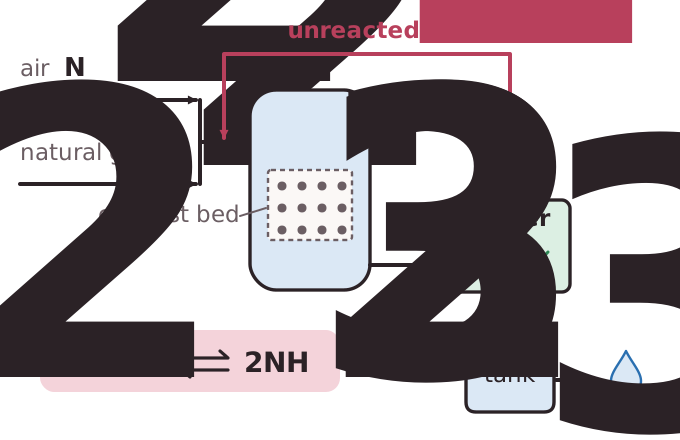
The Haber process makes ammonia, NH3, from nitrogen and hydrogen. The nitrogen is taken from the air, which is about 78% nitrogen. The hydrogen is made from natural gas, which is mainly methane, by reacting it with steam.
The reaction is reversible. Nitrogen and hydrogen combine to form ammonia, but ammonia also breaks down again into nitrogen and hydrogen. We show this with the symbol ⇌ in the equation: N2 + 3H2 ⇌ 2NH3. Every one nitrogen molecule that reacts makes two molecules of ammonia.
In a closed reactor the forward and backward reactions carry on at the same rate once a dynamic equilibrium is reached. The amounts of each gas then stay constant. Because the reaction never goes fully to completion, the gases leaving the reactor are a mixture of ammonia, nitrogen and hydrogen.
The conditions are a temperature of 450 °C, a pressure of 200 atmospheres and an iron catalyst. The mixture is cooled so that the ammonia turns into a liquid and can be removed. The unreacted nitrogen and hydrogen are recycled back into the reactor.