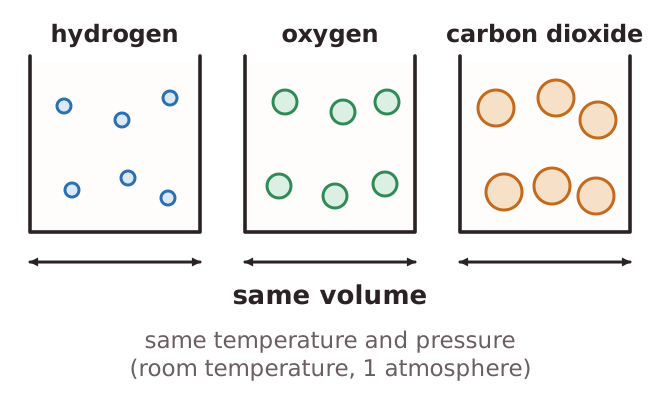
The particles in a gas are very far apart, so the space taken up by a gas depends on how many molecules there are, not on how big each molecule is. This means that equal numbers of molecules of different gases take up the same volume, as long as the temperature and pressure are the same.
The molar volume of a gas is the volume occupied by one mole of its molecules. At room temperature and pressure (about 20 °C and 1 atmosphere) it is the same for every gas: 24 dm3, which is the same as 24 000 cm3. In calculations the exam will give you this value.
You can use it to convert between moles and volume. Number of moles = volume in dm3 / 24, and volume in dm3 = number of moles x 24. If the volume is in cm3, divide by 24 000 instead. For example, 0.5 mol of carbon dioxide has a volume of 0.5 x 24 = 12 dm3, and 48 dm3 of oxygen is 48 / 24 = 2 mol. Remember 1 dm3 = 1000 cm3.